Importance of Manufacturing
The manufacturing sector is considered the backbone of development due to the following reasons:
- Manufacturing industries help in modernising agriculture as it provides jobs in secondary and tertiary sectors.
- It helps in the eradication of unemployment and poverty.
- Export of manufactured goods expands trade and commerce, and brings in much needed foreign exchange.
- It helps in prospering the country by giving a boost to the economy.
Contribution of Industry to National Economy
The trend of growth rate in manufacturing over the last decade has been around 7 per cent per annum.
Industrial Location
Industrial locations are influenced by the availability of:
- Raw material
- Labour
- Capital
- Power
- Market
- Government policies
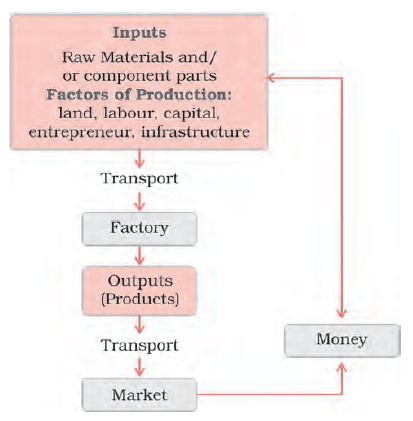
Manufacturing activity tends to locate at the most appropriate place where all the factors of industrial location are either available or can be arranged at a lower cost. The figure below shows the industry market linkage.
Agro-based Industries
Cotton, jute, silk, woollen textiles, sugar and edible oil, etc. industries are based on agricultural raw materials. Let’s know about each of them, one by one.
Textile Industry
It is the only industry in India, which is self-reliant and complete in the value chain i.e., from raw material to the highest value added products. It contributes to industrial production, employment generation and foreign exchange earnings.
Cotton Textiles
This industry has close links with agriculture and provides a living to farmers, cotton boll pluckers and workers engaged in ginning, spinning, weaving, dyeing, designing, packaging, tailoring and sewing. It supports many other industries, such as, chemicals and dyes, packaging materials and engineering works.
Jute Textiles
India is the largest producer of raw jute and jute goods. Most of the mills are located in West Bengal, mainly along the banks of the Hugli river.
Sugar Industry
India stands second as a world producer of sugar but occupies the first place in the production of Gur and Khandsari. This industry is seasonal in nature.
Mineral-based Industries
Industries that use minerals and metals as raw materials are called mineral-based industries. Let’s discuss some industries that fall under this category.
Iron and Steel Industry
Iron and steel is the basic industry as all the other industries – heavy, medium and light, depend on it for their machinery. lt is considered as a heavy industry because all the raw materials, as well as finished goods, are heavy and bulky entailing heavy transportation costs.
India is an important iron and steel producing country in the world yet, we are not able to perform to our full potential largely due to:
- High costs and limited availability of coking coal
- Lower productivity of labour
- Irregular supply of energy
- Poor infrastructure.
Aluminium Smelting
Aluminium Smelting is the second most important metallurgical industry in India. It is used to manufacture aircraft, utensils and wires. Bauxite is the raw material used in the smelters.
Aluminium Smelting has gained popularity as a substitute for steel, copper, zinc and lead in a number of industries. It exhibits the following properties:
- Light in weight
- Resistant to corrosion
- A good conductor of heat
- Malleable
- Becomes strong when it is mixed with other metals
Chemical Industries
The Chemical industry comprises both large and small scale manufacturing units. Rapid
growth has been recorded in both inorganic and organic sectors.
Inorganic chemicals include sulphuric acid nitric acid, alkalies, soda ash and caustic soda.
Organic chemicals include petrochemicals, which are used for manufacturing synthetic fibers, synthetic rubber, plastics, dye-stuffs, drugs and pharmaceuticals.
Fertilizer Industry
The fertilizer industries are centred around the production of nitrogenous fertilizers (mainly urea), phosphatic fertilizers and ammonium phosphate (DAP) and complex fertilizers which have a combination of nitrogen (N), phosphate (P), and potash (K). Gujarat, Tamil Nadu, Uttar Pradesh, Punjab and Kerala contribute towards half of the fertilizer production.
Cement Industry
Cement is essential for construction activity such as building houses, factories, bridges, roads, airports, dams and for other commercial establishments. This industry requires bulky and heavy raw materials like limestone, silica and gypsum.
Automobile Industry
This industry deals with the manufacturing of trucks, buses, cars, motorcycles, scooters, three-wheelers and multi-utility vehicles. These industries are located around Delhi, Gurugram, Mumbai, Pune, Chennai, Kolkata, Lucknow, Indore, Hyderabad, Jamshedpur and Bengaluru.
Information Technology and Electronics Industry
The electronics industry covers a wide range of products from transistor sets to television, telephones, cellular telecom, telephone exchange, radars, computers and many other equipment required by the telecommunication industry. This industry has generated employment in India. Bengaluru is known as the electronic capital of India.
Industrial Pollution and Environmental Degradation
Industries are responsible for 4 types of pollution:
- Air
- Water
- Land
- Noise
Air pollution is caused by the presence of a high proportion of undesirable gases, such as sulphur dioxide and carbon monoxide. Smoke is emitted by chemical and paper factories, brick kilns, refineries and smelting plants, and burning of fossil fuels leads to air pollution. It adversely affects human health, animals, plants, buildings and the atmosphere as a whole.
Water pollution is caused by organic and inorganic industrial wastes and effluents discharged into rivers. The industries which are mainly responsible for water pollution are paper, pulp, chemical, textile and dyeing, petroleum refineries, tanneries and electroplating industries.
Thermal pollution of water occurs when hot water from factories and thermal plants is drained into rivers and ponds before cooling.
Noise pollution is the propagation of noise with harmful impact on the activity of human or animal life. It results in irritation, anger, cause hearing impairment, increased heart rate and blood pressure.
Control of Environmental Degradation
Here are some ways through which industrial pollution can be reduced:
- Minimising the use of water by reusing and recycling it.
- Harvesting rainwater to meet water requirements.
- Treating hot water and effluents before releasing them in rivers and ponds.
- Particulate matter in the air can be reduced by fitting smoke stacks to factories with electrostatic precipitators, fabric filters, scrubbers and inertial separators.
- Smoke can be reduced by using oil or gas instead of coal in factories.
- Machinery can be redesigned to increase energy efficiency and reduce noise.
For Information On Industrial Waste and Pollution Control, Watch The Below Video:
Frequently Asked Questions on CBSE Class 10 Geography Chapter 6: Manufacturing Industries
What is the function of an industry?
The production of goods is the main function of any industry.
What are the types off industry?
1. Primary 2. Secondary 3. Tertiary 4. Quaternary
Which is the state that has maximum number of factories in India?
Tamil Nadu is the state in India that has the maximum number of factories.
Transport
Movement of goods and services can be over three important domains of our earth i.e. land, water and air. Based on these, transport can also be classified into the land, water and air transport. Let’s discuss them in detail:
Roadways
India has one of the largest road networks in the world, aggregating to about 54.7 lakh km. The growing importance of road transport over rail transport is mentioned below:
- The construction cost of roads is much lower than that of railway lines.
- Roads can cover more geographically harder locations that cannot be done by the railways.
- Roads can negotiate higher gradients of slopes and can be easily built-in traverse mountains such as the Himalayas.
- Road transport is economical.
- It also provides door-to-door service
- Road transport provides links between railway stations, air and seaports.
In India, roads are classified in the following six classes according to their capacity.
Golden Quadrilateral Super Highways
Golden Quadrilateral is a network of Highways connecting India’s four top metropolitan cities, namely Delhi, Kolkata, Chennai, Mumbai. These highway projects are being implemented by the National Highway Authority of India (NHAI).
National Highways
The National highways are a network of trunk roads that are laid and maintained by the Central Public Works Department (CPWD). The historical Sher-Shah Suri Marg is called National Highway No.1, between Delhi and Amritsar.
State Highways
Roads linking a state capital with different district headquarters are known as State Highways. These roads are constructed and maintained by the State Public Works Department (PWD).
District Roads
These roads connect the district headquarters with other places of the district. These roads are maintained by the Zila Parishad.
Other Roads
Rural roads, which link rural areas and villages with towns, are classified under this category. These roads received special impetus under the Pradhan Mantri Grameen Sadak Yojana.
Border Roads
Border Roads Organisation constructs and maintains roads in the bordering areas of the country. This organisation was established in 1960 for the development of the roads of strategic importance in the northern and north-eastern border areas.
Roads can also be classified on the basis of the type of material used for their construction such as:
- Metalled roads may be made of cement, concrete or even bitumen of coal. These are all-weather roads.
- Unmetalled roads go out of use in the rainy season.
Railways
Railways are the principal mode of transportation for carrying huge loads and bulky goods for long and short distances in India. Railways have become more important in India’s economy. However, rail transport suffers from certain problems as well, which are mentioned below:
- Construction of bridges is required across rivers’ wide beds for laying down the railway lines.
- In the hilly terrains of the peninsular region, railway tracks are laid through low hills, gaps or tunnels.
- The Himalayan mountainous regions are also unfavourable for the construction of railway lines due to the highest elevation points in the surface, sparse population and lack of economic opportunities.
- It is difficult to lay railway lines on sandy plains.
Pipelines
Pipeline network uses pipes, usually underground, to transport and distribute fluids. These are used to transport water, crude oil, petroleum products and natural gas, fertilizer factories and big thermal power plants. Solids can also be transported through a pipeline when converted into slurry.
There are 3 important networks of pipeline transportation in the country.
- From oil field in upper Assam to Kanpur (Uttar Pradesh)
- From Salaya in Gujarat to Jalandhar in Punjab
- From Hazira in Gujarat to Jagdishpur in Uttar Pradesh
Waterways
Waterways are the cheapest means of transport. They are most suitable for carrying heavy and bulky goods. It is a fuel-efficient and environment-friendly mode of transport.
The National Waterways in India are:
- N.W. No.1 – The Ganga river between Allahabad and Haldia (1620 km).
- N.W. No.2 – The Brahmaputra river between Sadiya and Dhubri (891 km).
- N.W. No.3 – The West-Coast Canal in Kerala (Kottapurma-Kollam, Udyogamandal and Champakkara canals-205 km).
- N.W. No.4 – Specified stretches of Godavari and Krishna rivers along with Kakinada Puducherry stretch of canals (1078 km).
- N.W. No.5 – Specified stretches of river Brahmani along with Matai river, delta channels of Mahanadi and Brahmani rivers and East Coast Canal (588 km).
Inland waterways in India are Mandavi, Zuari and Cumberjua, Sunderbans, Barak and backwaters of Kerala through which transportation takes place.
Major Sea Ports
India’s trade with foreign countries is carried from the ports. There are 2 major and 200 notified non-majors (minor/intermediate) ports in India.
Here is the list of major ports in India:
- Kandla in Kachchh was the first port to be developed after independence. It is also known as the Deendayal Port.
- Mumbai is the biggest port with a spacious natural and well-sheltered harbour.
- Marmagao port (Goa) is the premier iron ore exporting port of India.
- Mangalore port, located in Karnataka caters to the export of iron ore.
- Kochchi is the extreme south-western port, located at the entrance of a lagoon.
- Tuticorin port is situated at the extreme south-east.
- Chennai is one of the oldest artificial ports of India.
- Visakhapatnam is the deepest landlocked and well-protected port
- Paradwip port located in Odisha, specialises in the export of iron ore.
- Kolkata is an inland riverine port.
- Haldia port was developed as a subsidiary port, in order to relieve growing pressure on the Kolkata port.
Airways
The airway is the fastest, most comfortable and prestigious mode of transport. Air travel has made access easier to the terrain areas like high mountains, dreary deserts, dense forests and long oceans. The air transport was nationalised in 1953. Air India provides domestic and international air services.
Pawanhans Helicopters Ltd. provides helicopter services to Oil and Natural Gas Corporation in its off-shore operations, to inaccessible areas and difficult terrains. But, air travel is not within the reach of the common people.
To Know About Smart Cities Of India, Watch The Below Video:
Communication
The major means of communication in India are television, radio, press, films, etc.
The Indian postal network is the largest in the world. It handles parcels as well as personal written communications.
- First-class mail is airlifted between stations covering both land and air.
- Second-class mail includes book packets, registered newspapers and periodicals. They are carried by surface mail, covering land and water transport.
India has one of the largest telecom networks in Asia. The Subscriber Trunk Dialling (STD) facilities all over India have been made possible by integrating the development in space technology with communication technology.
- Mass communication provides entertainment and creates awareness among people about various national programmes and policies. It includes radio, television, newspapers, magazines, books and films.
- India Radio Channel (Akashwani) broadcasts a variety of programmes in national, regional and local languages.
- Doordarshan, the national television channel is one of the largest terrestrial networks in the world.
- India publishes a large number of newspapers in about 100 languages and dialects.
International Trade
The exchange of goods among people, states and countries is referred to as trade. Trade between two countries is called international trade. It is considered as the economic barometer for a country. Export and import are the components of trade. The balance of trade of a country is the difference between its export and import.
- When the value of export exceeds the value of imports, it is called a favourable balance of trade.
- If the value of imports exceeds the value of exports, it is termed as an unfavourable balance of trade.
The commodities exported from India to other countries include gems and jewellery, chemicals and related products, agriculture and allied products, etc.
The commodities imported to India include petroleum crude and products, gems and jewellery, chemicals and related products, base metals, electronic items, machinery, agriculture and allied products.
Tourism as a Trade
More than 15 million people are directly engaged in the tourism industry. Tourism in India:
- Promotes national integration
- Provides support to local handicrafts and cultural pursuits
- Helps in the development of international understanding about Indian culture and heritage. Foreign tourists visit India for heritage tourism, eco tourism, adventure tourism, cultural tourism, medical tourism and business tourism.
An economy is the large set of inter-related production and consumption activities that aid in determining how scarce resources are allocated.